
Awomo Introduces SimDataEngine: From Interactive 3D Worlds to Robot Training Data
Awomo’s PhysicalRSI team introduces Awomo-SimDataEngine, an automated system that connects 3D asset and scene generation with robot demonstration synthesis. Starting from images or text, it builds interactive environments, validates their physical properties, and generates demonstrations for robot learning.
On the public LIBERO-Plus benchmark, a World-Action Model co-trained with the SimData-Ultra configuration achieved 89.43% overall success, compared with 77.17% for benchmark-only training, when comparing each configuration’s best evaluated checkpoint within 13,000 training steps.
Building Worlds Robots Can Interact With
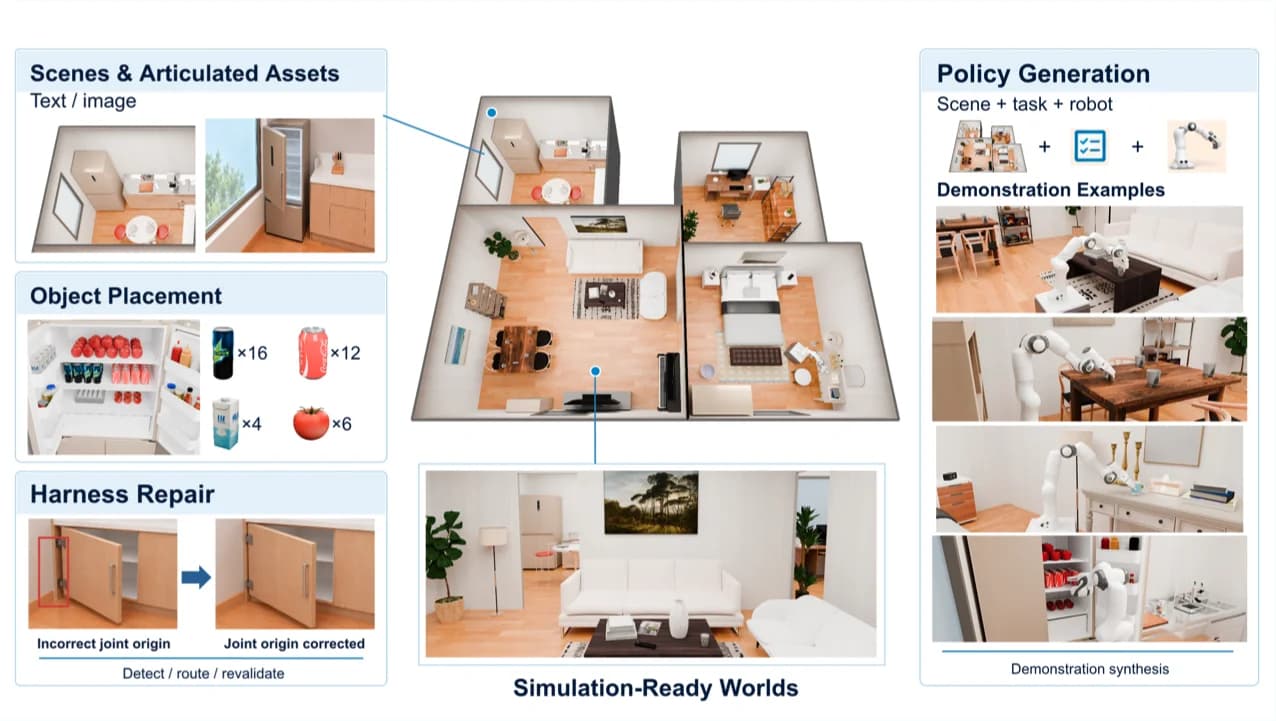
Robot training requires objects with working joints, environments that satisfy physical constraints, and tasks that can be replayed reliably. SimDataEngine brings these requirements into a shared workflow, connecting asset generation, scene construction, validation, repair, and demonstration collection.
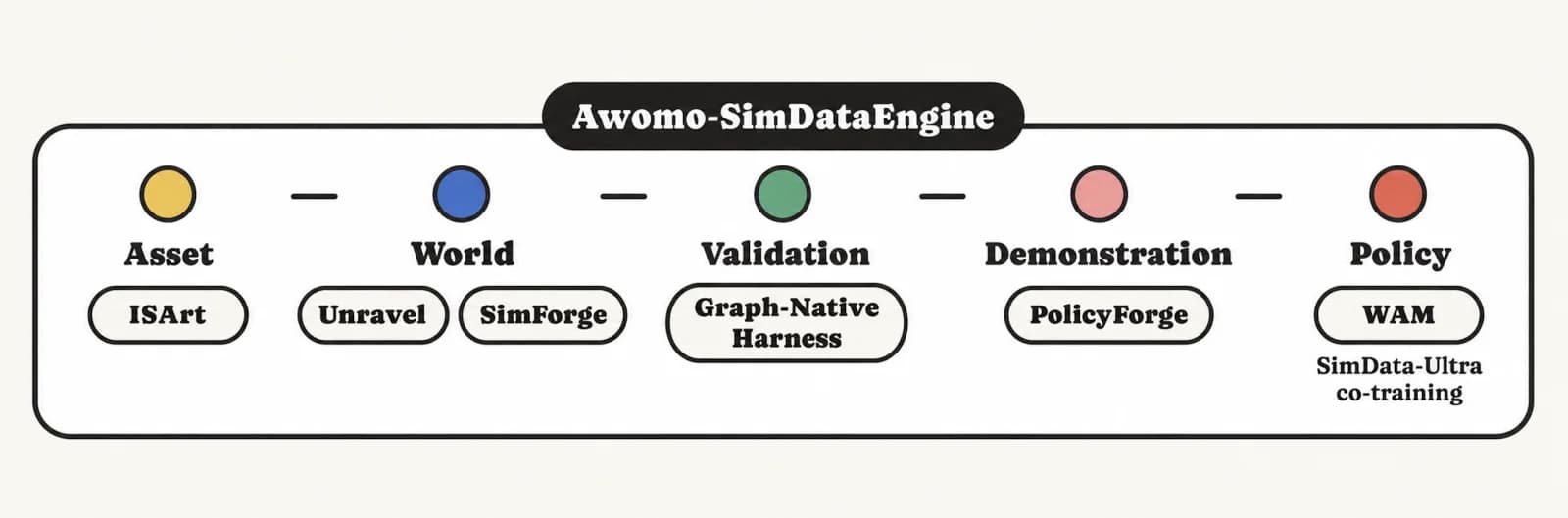
ISArt generates articulated assets from a single object image. It predicts part structure and joint information, then incorporates these constraints into 3D generation. The resulting assets include individual part meshes and a kinematic description specifying joint origins, axes, and motion ranges. Simulation tests and video-based checks identify issues such as incorrect motion, part interference, or collisions, allowing the system to revise the asset.
Scene construction follows two complementary routes. Unravel reconstructs editable environments from a single image by progressively removing foreground objects, recovering occluded regions, and reassembling independently generated assets. SimForge creates single-room scenes and multi-room environments from text descriptions, coordinating layout planning, asset acquisition, placement, physical validation, and simulator packaging.
Connecting Validated Scenes to Training Data
Once a world has passed validation, PolicyForge combines it with a task description, robot embodiment, and reset specification to generate robot demonstrations.
The system breaks tasks into executable steps and selects suitable planning or control methods. During execution in Isaac Sim, it records multi-camera RGB observations, robot proprioception, and actions. Only episodes that meet the task-success criteria enter the training dataset.
A shared Graph-Native Harness coordinates construction, validation, and local repair throughout the workflow. When a check fails, the system records evidence, identifies the responsible module, and limits repair to the affected components. Validated scene state remains available for reuse, reducing the need to rebuild entire environments.
Evaluating the Impact on Robot Learning
The team evaluated the training value of the generated demonstrations by co-training a World-Action Model with data produced in Isaac Sim and testing it on the LIBERO-Plus benchmark.
Among evaluated checkpoints up to and including 13,000 training steps, the SimData-Ultra co-training configuration achieved its best overall success rate of 89.43% at 13K steps. The benchmark-only baseline reached its best of 77.17% at 9K steps, a difference of 12.26 percentage points.
At these selected checkpoints:
- Goal generalization increased from 52.51% to 84.17%, a gain of 31.66 percentage points.
- Object generalization improved by 8.34 percentage points.
- Spatial generalization improved by 6.25 percentage points.
- Long-horizon LIBERO-10 performance improved by 1.99 percentage points.
SimData-Ultra is a combined co-training configuration incorporating SimData-Hard, additional in-house demonstrations, and LIBERO-Plus data with robot initial-state and language augmentation. The results reflect this combined configuration.
These findings support the value of generated simulation data for cross-simulator policy training, with the strongest gains in goal generalization and more limited improvements on long-horizon tasks.
A Connected Workflow for Physical AI Data
Awomo-SimDataEngine establishes a workflow from interactive assets and validated worlds to robot demonstrations and policy training. By connecting generation with execution and repair, it provides a practical foundation for producing training data for Physical AI.
Explore the system, demos, and results: